Free unit economics tool, no sign-up
What does your paddle actually cost you?
Your dashboard shows one margin. Freight, duties, packaging, 3PL and marketplace fees show you a different one. Move the sliders, the real numbers update as you go.
Runs entirely in your browser. Nothing you type is sent anywhere.
Landed cost and margin calculator
Contribution margin
$34.29 · 45.7%
What's left per paddle after every variable cost.
Break-even price
$36.53
Below this you lose money on every unit.
True landed cost
$24.25
Factory + freight + duties + packaging.
Your numbers
List price, before discounts and returns.
Promo codes, sales and bundles, as a share of list price.
Share of orders sent back. A return loses the sale, keeps the marketplace fee, and costs one more fulfilment leg to process.
Ex-works unit price from your manufacturer.
Ocean or air freight, duty, port and drayage, per unit.
Retail box, insert, poly bag, anything that ships with the paddle.
Pick, pack and outbound shipping per order.
Amazon referral, Shopify payment fees, wholesale discount. Toggle to $ for a flat fee.
Only used to scale the gap to an annual figure.
Your unit economics
Your dashboard says 77.2%. You're keeping 45.7%.
That's a gap of 31.5 points, $23.66 per paddle. Most brands never see it, because the costs that create it show up in four different places in the books.
At 5,000 units a year, that gap is $118,288.
At these discount, return and fee rates there's no price that breaks even.
Where the money goes
| Cost | Per unit | % of net revenue |
|---|
The full model
One paddle is the easy part.
This runs the numbers for a single SKU at a single price. The version that actually changes decisions covers every SKU you sell, costed separately across DTC, Amazon and wholesale, because the same paddle rarely earns the same margin in all three.
Send us your numbers and we'll build that model for you. Free, and you keep it.
- Every SKU, not just one
- DTC, Amazon and wholesale costed separately
- Yours to keep, whether or not you work with us
Got it.
Your model is on its way to , 5 business days. If anything in your numbers doesn't add up we'll email one question rather than guess.
What a landed cost calculator has to account for
What "landed cost" actually includes
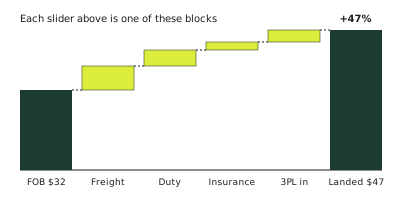
Landed cost is everything it takes to get one finished unit into your warehouse, ready to sell. Most founders count the factory invoice and stop there. The factory invoice is usually about two-thirds of the real number.
 Open diagram as SVG
Duty varies by material and country of origin, not by category. A composite paddle and a wood paddle can enter the US under different HTS codes at different rates. Change the face material mid-development and the duty line moves with it, a paddle that landed at 3.2% duty can land at 7.5% on the next run without a word from the factory, because classifying the goods is your responsibility, not theirs.
Tooling and setup belong to the units that shipped, not the units you planned. A $6,000 mould amortised across a forecast 10,000-unit run is $0.60 a paddle. If the first run is 3,000 units, those paddles carry $2.00 each. Amortising against the forecast rather than the actual run is the single most common way a landed cost is understated, and it flatters exactly the units you're pricing off.
Freight is quoted per container and paid per unit. A $4,200 40-foot container carrying 2,400 paddles is $1.75 a unit. The same container at 1,600 units, because the packaging got bigger, or you shipped early to beat a deadline, is $2.63. Freight cost per unit is a function of how well you filled the box, and it changes every run.
Then the costs after the port. Customs brokerage, port fees, drayage to the 3PL, and receiving charges to get the pallets put away. Individually they look like admin. Added up they're often $0.50 to $1.50 a unit, real money against a $79 paddle, and money that never appears in your cost of goods because it arrives as three separate invoices from three vendors.
And the packaging. If the retail box, insert card and poly bag ship from the factory attached to the paddle, they're landed cost. That's the test: did it cross the border as part of the unit?
Why your Shopify margin is wrong
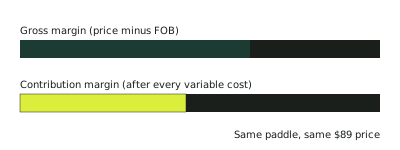
Shopify knows two things: what you charged, and what you told it the item cost. That's it. It does not know about your freight invoice, because that came from a forwarder. It does not know about your customs entry, because that came from a broker. It does not know what your 3PL charged to pick and pack, because that's a monthly statement. And it does not know about the referral fee Amazon took, because that settlement lands in a different system entirely.
 Open diagram as SVG
Each of those costs is real, each is variable, and each lives somewhere your ecommerce platform never looks. So the platform reports the only margin it can compute, price minus the cost field you typed in, and it reports it confidently. Nobody adds the rest up, because adding them up means opening four systems and agreeing on a denominator first.
That's the whole gap this calculator measures. Not an error, exactly. Just a number that answers a narrower question than the one you're asking it.
DTC vs Amazon vs wholesale
The same paddle earns three different margins, and the spread is wider than most brands assume. On Amazon, a 15% referral fee comes off what the customer actually paid, plus FBA fulfilment if you're using it. On wholesale, you're typically selling at 50% of MSRP, no marketplace fee, but a price that halves before any cost is counted. On DTC you keep the full price, and then pay for the traffic that produced it.
That last one matters, and this tool does not model it. A DTC channel running at a $22 blended acquisition cost is a materially worse channel than the contribution margin above suggests, and a wholesale account at 50% off with no ad spend can quietly be the better one. Per-channel numbers are the point at which a single-SKU calculator stops being enough.
What this calculator doesn't cover
Customer acquisition cost. Overhead, salaries, software, rent, your own time. Payment processing beyond the marketplace fee field. Inventory carrying cost and the working capital tied up in a container that lands ninety days before it sells. Obsolescence on discontinued SKUs and the markdowns it takes to clear them. Returns processing, as distinct from the revenue effect of returns. FX movement between the day you quote and the day you pay.
Contribution margin is the number that has to be positive before any of that is worth discussing, but it is a floor, not profit. Every item on that list is a reason the margin above is the best case, and a reason to want the multi-SKU model rather than one number for one paddle.
Questions founders ask us
Free, and no. The calculator runs entirely in your browser, nothing you type is sent anywhere. The email form above is only if you want the multi-SKU version.
Landed cost if it ships from the factory with the paddle. Fulfilment if your 3PL adds it. This calculator treats it as landed cost, if yours works the other way, put it in the 3PL field instead. The total is the same either way.
After. Amazon and Shopify take their cut of what the customer actually paid, so this calculates the fee on net revenue, not list price.
A returned paddle is assumed to be resold, so you don't lose the landed cost. You do lose the sale, you still pay the marketplace fee (Amazon keeps most of its referral fee on returns), and you pay one more fulfilment leg to get it back and re-shelved. Discounts are separate because they only cost you revenue.
Break-even is the floor, not a target. The gap between it and your price is what funds inventory, overhead, ads and profit. If the two are close, you have a pricing problem rather than a cost problem.
Yes. The defaults are paddle economics, but the arithmetic is the same for any physical product with overseas manufacturing.
Want this for every SKU you sell?
The Free Margin Leak Check covers your whole catalogue, costed across DTC, Amazon and wholesale. Same price as this page.
Free Margin Leak Check
Send us your numbers and we cost your whole catalogue across DTC, Amazon and wholesale. You get the real margin per SKU back.
Get the check 30 minutes, with a CFOBook a Strategic Call
Walk through your margins, cash and next production run with Muhammad. See what ongoing coverage would look like.
Book a Strategic Call