Operational Finance
Inventory bookkeeping that knows what a paddle actually costs you
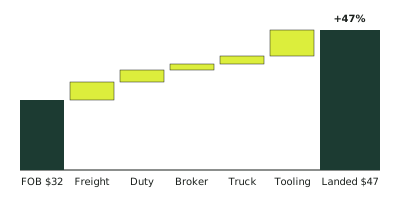
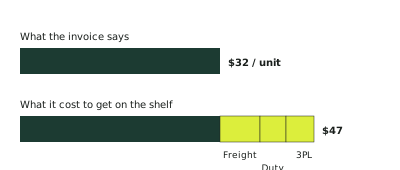
Your factory invoice is not your cost of goods. By the time a paddle reaches a customer, it has carried ocean freight, customs duty, brokerage, factory setup, inspection and inbound fulfillment. Most bookkeepers never put those costs on the unit.
The problem a generic accountant misses
A standard e-commerce bookkeeper records the factory invoice as inventory and sends everything else to operating expense. Freight lands in "shipping." Duties land in "taxes." Mold and tooling charges disappear into a one-off line nobody revisits.
 Open diagram as SVG
The result looks tidy and is quietly wrong. Gross margin looks healthier than it is, wholesale prices get set from FOB instead of landed cost, and the SKUs you believe are carrying the brand may be the ones eroding it. Add Shopify payouts net of fees, Amazon settlements that bundle a dozen charge types, and wholesale invoices on terms, and revenue becomes as unreliable as cost.
What we do
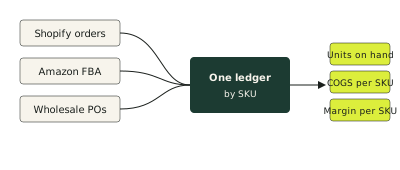
We keep your books at the level your business runs: the SKU. Every production run is costed in full, with freight, duties, brokerage and factory setup allocated to the units they belong to. Inventory moves onto the balance sheet at true landed cost and into cost of goods sold only when it sells.
 Open diagram as SVG
Revenue is reconciled channel by channel. Shopify, Amazon and wholesale payouts are broken back into sales, fees, refunds, discounts and gift cards, so each line in your P&L means what it says. The books are built in QuickBooks, usually alongside the tools you already use, with a chart of accounts designed for a gear brand rather than a generic retail template.
How It Works
How it works
 Open diagram as SVG
Discovery
We review your production history, channels and current books, and agree what needs rebuilding.
Cleanup and baseline
We reconcile back through your last full quarter, correct miscategorized costs and establish an opening inventory position you can trust.
Landed cost model
We build the allocation method for each production run and apply it to every SKU.
Monthly close
Your books are closed by day five, reconciled across every channel, with SKU-level COGS updated each month.
Deliverables
What you get
- 01A chart of accounts structured for a pickleball gear brand
- 02Landed cost per SKU, per production run, with freight, duties and setup allocated
- 03Monthly reconciliation of Shopify, Amazon and wholesale payouts
- 04Inventory valued correctly on the balance sheet
- 05Monthly P&L, balance sheet and cash flow statement, closed by day five
- 06Gross margin by SKU and by channel
Plans
Which plan includes it
Landed cost and SKU-level COGS tracking are part of Rally ($1,100–$2,400/month) and every plan above it. Dink covers monthly bookkeeping and reconciliation for brands that need clean books first. Compare plans.
To see what those margins mean channel by channel, pair this with Unit Economics & Multi-Channel Margins.
 Open diagram as SVG
FAQ
Frequently asked questions
Everything it takes to get a finished unit into sellable inventory: the factory price, ocean or air freight, customs duty, brokerage, inland transport, inspection, factory setup or tooling, and inbound 3PL receiving. We agree the exact list with you and apply it consistently.
Usually not. We work in QuickBooks alongside Shopify, Amazon and your 3PL. If your current setup cannot support SKU-level tracking, we will tell you what to add and why.
Yes. Most engagements begin with a one-time cleanup, quoted separately, before moving to a flat monthly package.
We allocate shared costs by a method that reflects how they are incurred, typically by volume, weight or value, and document it so the numbers hold up under review.
Start with one SKU
If you would rather judge the work than the résumé, send us your top SKU's pricing and we will build the landed-cost model first, before you commit to anything.
Try the Landed COGS Calculator for a single paddle, request a Free Margin Leak Check for your whole catalog, or book a strategic call. You will be working with Muhammad Ali, ACA directly.