Strategic CFO & Growth
R&D tax credits for paddle innovation
If your team develops its own cores, tests face materials or iterates through prototypes, some of that work may qualify for a federal tax credit. Many product brands never claim it.
The problem a generic accountant misses
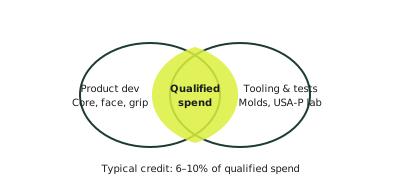
The federal research credit is often assumed to belong to laboratories and software companies. In practice, it can apply to product development of the kind paddle brands do every season: new core structures, carbon fiber and fiberglass face testing, edge guard and handle design, and repeated prototyping to meet performance and certification requirements.
 Open diagram as SVG
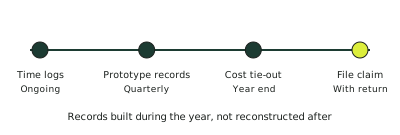
The credit reduces tax owed dollar for dollar, and qualifying small businesses may be able to apply part of it against payroll taxes, even before they are profitable. It also requires careful documentation. Claims need to show a technical uncertainty, a process of experimentation, and the costs connected to that work. A generic accountant rarely asks the questions that surface qualifying activity.
What we do
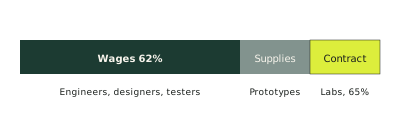
We review your development work to identify what may qualify under the federal rules. We then separate eligible costs, such as wages for staff involved in design and testing, materials consumed in prototyping, and eligible contractor costs, from those that do not qualify.
 Open diagram as SVG
One point matters particularly for gear brands: qualifying research generally has to be carried out in the United States. Design and testing done by your US team may qualify, while work performed by an overseas factory usually does not. We assess this carefully so your claim is built on solid ground.
Where a claim is supported, we prepare the calculation and the documentation behind it, and coordinate with your tax preparer on filing.
How It Works
How it works
 Open diagram as SVG
Assessment
We discuss your product development and identify activity that may qualify.
Cost review
We identify eligible wages, supplies and contractor costs from your books.
Documentation
We build the supporting record: projects, uncertainties, testing and costs.
Claim
We prepare the credit calculation and work with your preparer to include it in your return.
Deliverables
What you get
- 01An assessment of which development activities may qualify
- 02Identification of eligible wages, supplies and contractor costs
- 03A credit estimate before any filing work begins
- 04Supporting documentation prepared to withstand review
- 05Credit calculation and coordination with your tax preparer
- 06Guidance on tracking qualifying work going forward
Plans
Which plan includes it
An R&D tax credit assessment is included in Third Shot ($1,000–$1,500/month). R&D tax credit filing and documentation are included in Kitchen Line ($2,000–$2,900/month). Compare plans.
The credit sits alongside your wider tax position; see E-Commerce Tax & Compliance.
 Open diagram as SVG
FAQ
Frequently asked questions
It depends on the work your team does and where it is done. If you design, test or develop products in the United States, a short assessment will tell you whether a claim is worth pursuing.
Possibly. Qualifying small businesses may be able to apply part of the credit against payroll taxes. We will check whether you meet the requirements.
Routine manufacturing does not qualify, and research carried out outside the United States generally does not either. Design and testing done by your own US team may.
No. Eligibility depends on your facts and the current federal rules. We only recommend a claim where the work and documentation support it.
Get a free assessment of your claim
Book a strategic call and we will review your development work with you. Meanwhile, try the Landed COGS Calculator or request a Free Margin Leak Check. Meet the founder.
Note: This page provides general information, not tax advice. Eligibility for the federal research credit depends on individual circumstances and current law.