Strategic CFO & Growth
Financials that survive diligence
Buyers and investors do not pay for the business you describe. They pay for the business your numbers can prove.
The problem a generic accountant misses
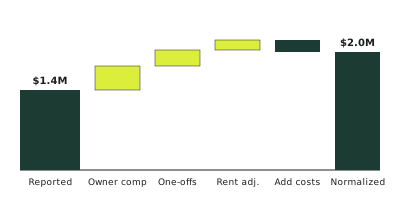
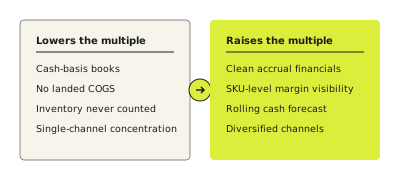
Books kept for tax filing are rarely ready for diligence. Owner expenses run through the business. One-off costs sit alongside recurring ones. Inventory is valued inconsistently, freight sits in operating expense, and margin by channel cannot be shown. Each issue gives a buyer a reason to lower the price, add conditions, or walk away.
 Open diagram as SVG
Pickleball has drawn real interest from investors and larger sporting goods companies. That interest rewards brands that can present clean, consistent, defensible financials, and penalizes those that cannot.
What we do
We prepare your financials to the standard buyers and investors expect. Your founder brings Big Four audit experience, so we look at your numbers the way a diligence team will.
 Open diagram as SVG
We build normalized EBITDA, adjusting for owner compensation, one-off costs and non-recurring items, with each adjustment documented. We restate inventory and cost of goods on a consistent landed-cost basis. We produce SKU-level and channel-level margins that support your growth story. We prepare a data room of financial statements, reconciliations and schedules, and support you through buyer questions.
The same work serves you if the goal is not a sale: a funding round, a bank facility, or a major retail partnership.
Why it matters in a sale
Valuations for consumer product brands are commonly expressed as a multiple of earnings. Every dollar of earnings a buyer cannot verify is a dollar they will not pay a multiple on. Every unexplained inventory adjustment becomes a question, and every question takes time during the most sensitive stage of a deal.
Preparation changes that dynamic. When your normalized earnings are documented, your inventory reconciles and your margins can be shown by product and by channel, diligence moves faster and negotiations focus on the future of the brand rather than the reliability of its past. You enter the conversation knowing what your numbers will show, before a buyer finds it for you.
How It Works
How it works
 Open diagram as SVG
Readiness review
We assess your financials against what a buyer or investor will examine.
Clean up and restate
We correct inconsistencies, standardize inventory and cost treatment, and document adjustments.
Build the package
We prepare normalized EBITDA, margin analysis and diligence-ready statements.
Support the process
We answer financial questions from buyers, investors and their advisers.
Deliverables
What you get
- 01A readiness assessment with prioritized fixes
- 02Normalized EBITDA with documented adjustments
- 03Diligence-ready financial statements
- 04SKU-level and channel-level margin analysis
- 05An organized financial data room
- 06Support during diligence and negotiation
Plans
Which plan includes it
Exit readiness and normalized EBITDA reporting are included in Match Point (custom pricing), alongside weekly strategy calls and a direct line to your CFO. Compare plans.
Exit readiness works best after a period of strong CFO oversight; see Fractional CFO Strategy.
Starts in
Match PointCustom pricing. Weekly strategy calls and a direct line to your CFO.
Compare plans →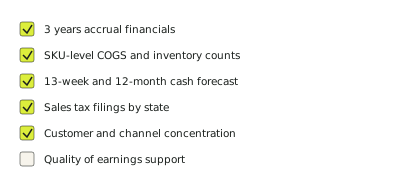 Open diagram as SVG
FAQ
Frequently asked questions
Ideally a year or more before a transaction, so buyers see a consistent track record. Shorter timelines are possible, with more work up front.
We prepare the financial foundation a valuation rests on, including normalized EBITDA and margin analysis. Where a formal independent valuation is required, we work alongside the valuation firm.
No. The same preparation supports fundraising, lending and large retail partnerships.
Yes. We coordinate with your advisers and handle the financial side of diligence.
Prepare your pickleball brand for the close
Book a strategic call to review where your financials stand today. To start with the numbers, try the Landed COGS Calculator or request a Free Margin Leak Check. Meet the founder.